
Kashiyama NeoDry Dry Vacuum Pumps
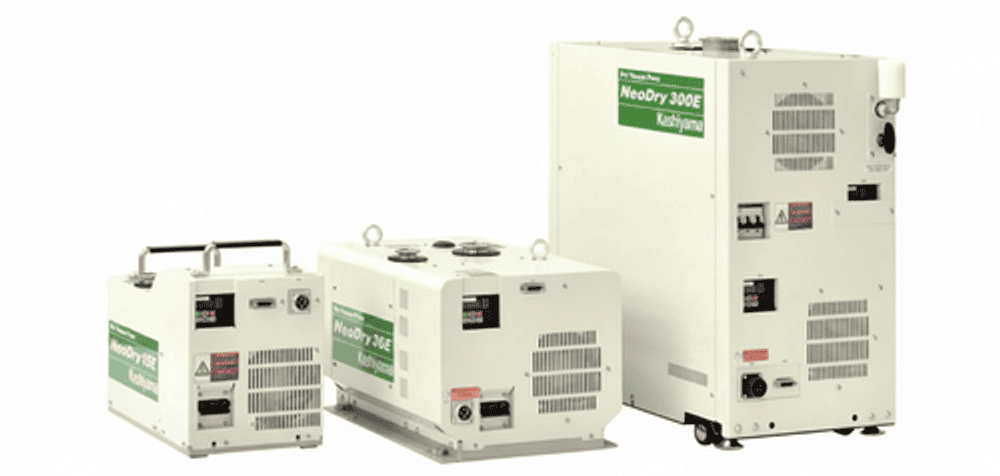
Kashiyama
Kashiyama NeoDry 300E
Contact us for pricing
Kashiyama
Kashiyama NeoDry 100E
Contact us for pricing
Kashiyama
Kashiyama NeoDry 60E
Contact us for pricing
Kashiyama
Kashiyama NeoDry 36E
Contact us for pricing

Kashiyama
Kashiyama NeoDry 30E
Contact us for pricing

Kashiyama
Kashiyama NeoDry 15E
Contact us for pricing
Kashiyama
Kashiyama NeoDry 7E
Contact us for pricing

Kashiyama
Kashiyama NeoDry 36G
Contact us for pricing
Kashiyama
Kashiyama NeoDry 30G
Contact us for pricing
Kashiyama
Kashiyama NeoDry 15G
Contact us for pricing
Kashiyama
Kashiyama NeoDry 7G
Contact us for pricing
Kashiyama NeoDry Dry Vacuum Pumps
Kashiyama NeoDry pumps are compact, oil-free dry pumps that reach about 1 Pa (7.5 mTorr) without any oil in the pumping chamber. They are a direct replacement for small oil-sealed rotary vane and scroll pumps where clean, quiet vacuum matters.
Kashiyama, a Japanese dry pump maker, builds NeoDry pumps across a wide range of sizes for labs, analytical instruments and semiconductor and flat panel tools. At Provac Sales, we supply Kashiyama NeoDry pumps and help you size them to your system.
Kashiyama NeoDry Models We Carry
NeoDry E Series
- NeoDry 15E, about 250 L/min (8.8 CFM)
- NeoDry 30E, about 500 L/min (17.7 CFM)
- NeoDry 36E, about 600 L/min (21.2 CFM)
- NeoDry 60E, about 1,000 L/min (35.3 CFM), single-phase 200 to 240 V
- NeoDry 100E and 300E, larger frames for high-flow roughing and load locks
The 15E to 60E reach about 1 Pa (7.5 mTorr) ultimate pressure without gas ballast.
NeoDry G Series
- NeoDry 7G, about 110 L/min, ultimate about 5 Pa
- NeoDry 15G, about 250 L/min, ultimate about 1 Pa
- NeoDry 30G, about 500 L/min, ultimate about 0.7 Pa
- NeoDry 36G, about 600 L/min, ultimate about 0.7 Pa
G series pumps switch automatically between 100 V and 200 V single-phase power.
Some listings show a price and others are quote-based. Each product page lists pumping speed, ultimate pressure, voltage and connections.
E Series vs G Series
- The NeoDry E series covers the widest range of sizes, from the 15E up to the 300E. It is the usual choice for roughing chambers, load locks and backing larger turbo pumps.
- The NeoDry G series is built for labs and instruments. It runs on single-phase power from 100 to 240 V, switching automatically, and is very quiet, about 45 dB at ultimate pressure on most sizes. Fan control keeps the pump at the right temperature.
How a Multi-Stage Roots Dry Pump Works
Two Roots-type rotors with several lobes on each shaft turn in opposite directions inside a series of chambers. Timing gears keep the rotors from touching each other or the housing.
Each stage traps gas and passes it to the next stage, compressing it a little more each time until it leaves at atmospheric pressure.
Because the rotors never touch and there is no oil in the pumping chamber, the exhaust stays clean. Oil is used only for the gears and bearings, sealed away from the pumped gas.
Key Features
- No oil in the pumping chamber, so clean exhaust and no backstreaming
- Ultimate pressure of about 1 Pa on most models
- Very quiet operation, suited to labs and offices
- Compact, air-cooled design with no cooling water needed
- Gas ballast for pumping water vapor
- Maintenance-free for about three years on clean air or nitrogen service
Applications for Kashiyama NeoDry Dry Pumps
- Backing turbomolecular pumps
- Load lock and transfer chamber roughing
- Semiconductor and flat panel display tools
- Mass spectrometers, electron microscopes and analytical instruments
- Thin film deposition and sputtering systems
- Replacing oil-sealed rotary vane and scroll pumps in clean labs
How to Choose the Right Kashiyama NeoDry Pump
Before ordering, confirm:
- Pumping speed needed for your chamber volume and pumpdown time
- The foreline pressure your turbo pump needs, if you are backing one
- Water vapor or process gas load, and whether gas ballast is needed
- Supply voltage and phase
- Inlet and outlet flange sizes
- Noise and space limits at the install location
A NeoDry 15E to 60E is a good replacement for older 8 to 35 CFM oil-sealed or scroll pumps.
Maintenance Tips
- Keep the inlet filter clean and fit an inlet screen on dusty processes
- Use gas ballast when pumping water vapor
- Keep the cooling fan and air paths clear
- Run the pump with the inlet closed for a short time after pumping condensable vapors
- Plan overhaul at about three years on clean service, sooner on harsh processes
Signs Your Dry Pump Needs Service
- The pump no longer reaches its rated ultimate pressure
- Longer pumpdown than before
- New noise, vibration or rattling, which can point to worn bearings
- The pump runs hot or trips on overload
- Process deposits building up at the inlet or exhaust
Why Switch to a Dry Pump
An oil-sealed rotary vane pump needs regular oil changes, can backstream oil into your system and puts oil mist into the room. A NeoDry pump removes all of that.
It reaches a similar rough vacuum, runs quietly and needs no routine oil service on the pumping side, which lowers running cost and keeps your chamber and lab clean. For turbo backing, the clean foreline also protects the turbo pump from oil contamination.
Kashiyama Dry Pumps Repair
Provac Sales services Kashiyama NeoDry dry pumps. Submit an RMA request and complete the contamination data sheet before shipping. See our pump repair page for more information.
Related Collections
- All Kashiyama vacuum pumps
- Leybold dry pumps, ECODRY and DRYVAC dry pumps
- Welch scroll pumps, oil-free scroll pumps for labs
- All dry pumps from every brand we carry
Find the Right Kashiyama NeoDry Dry Pump
Send us your chamber size, required pressure, the turbo pump you are backing if any, gas load and supply voltage. We will recommend the right NeoDry model and confirm availability.
Browse our inventory above or contact our vacuum specialists at 831-462-8900.
Kashiyama NeoDry Dry Pump FAQ
1. What ultimate pressure does a Kashiyama NeoDry pump reach?
Most NeoDry E series pumps, from the 15E to the 60E, reach about 1 Pa (7.5 mTorr) without gas ballast. The NeoDry 30G and 36G reach about 0.7 Pa.
2. Do Kashiyama NeoDry pumps need oil?
There is no oil in the pumping chamber. A small amount of oil lubricates the gears and bearings in a sealed chamber away from the pumped gas.
3. Can a NeoDry pump back a turbo pump?
Yes. Its ultimate pressure of about 1 Pa and clean, oil-free foreline make it well suited to backing turbomolecular pumps. Size the NeoDry to your turbo pump's gas load and foreline requirement.
4. What is the difference between NeoDry E and G series pumps?
The E series covers a wide size range up to the 300E for chamber roughing and load locks. The G series is a lab-focused line with automatic 100 to 240 V single-phase power and very quiet operation.
5. How often does a NeoDry pump need maintenance?
On clean air or nitrogen service, NeoDry pumps are maintenance-free for about three years. Harsh, dusty or condensing processes shorten that interval.